Using AI Vision Inspection to Detect Foreign Materials in Food Production
Ensuring food safety is a fundamental requirement for all food producers. Increasing production speeds, complex supply chains, and automated processing environments raise the risk that foreign materials - such as plastic, rubber, glass, wood, or paper - can enter the production line. Even small contaminants can result in product recalls, regulatory non-compliance, and significant reputational damage.
To address these challenges, manufacturers are increasingly combining AI-based vision inspection systems like SENSURE SYNAPSE software suite with industrial imaging hardware.
Foreign materials can be introduced at multiple points in the production process, including raw material handling, processing equipment, packaging operations, or environmental exposure. Traditional inspection methods - such as manual visual checks - are difficult to scale and maintain in high throughput production environments.
Human inspection is limited by fatigue and subjectivity, especially on fast-moving lines where thousands of products may be processed per minute. As a result, many manufacturers are moving toward automated inspection systems capable of analyzing 100% of production output, ensuring consistent and repeatable quality control.
Vision Technologies for Foreign Material Detection
Different vision technologies can be used depending on the characteristics of both the product and the potential contaminant. Selecting the appropriate imaging approach is critical to achieving reliable detection performance in industrial environments.
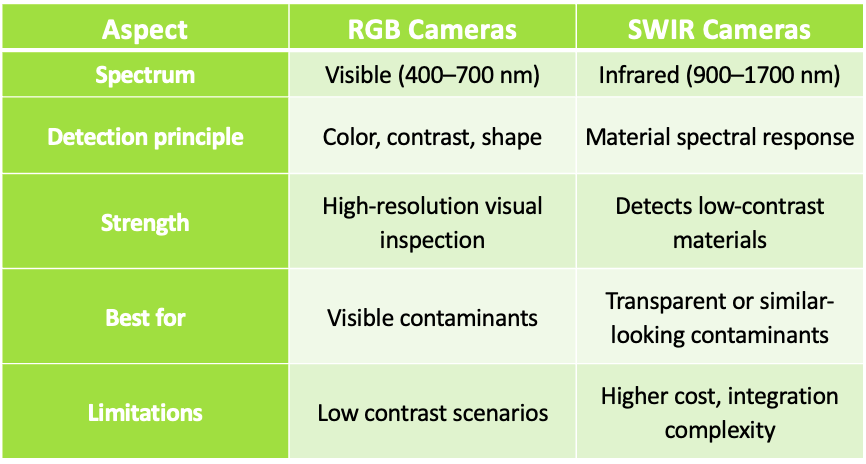
Standard 2D RGB cameras operate in the visible spectrum and detect foreign materials based on differences in color, contrast, shape, and surface texture. These systems are widely used due to their simplicity, cost-effectiveness, and ease of integration into existing production lines. RGB inspection performs well when contaminants are clearly distinguishable from the product - for example, colored plastic fragments, paper residues, or wood pieces on processed or packaged foods.
However, RGB-based inspection has inherent limitations. Its performance depends on visual contrast, which can be affected by product variability, lighting conditions, and the presence of ingredients with similar colors or textures. In many food applications, contaminants may be visually similar to the product, making reliable detection challenging using visible-light imaging alone.
The minimum detectable size of a foreign material depends on the imaging configuration, including camera resolution, field of view, optics, and image quality. Higher spatial resolution can enable the detection of smaller contaminants, provided sufficient visual contrast is available.
To address these limitations, manufacturers increasingly adopt short-wave infrared (SWIR) imaging as a complementary technology. SWIR cameras operate in a wavelength range typically between 900 and 1.700 nm and detect differences in the spectral response of materials, rather than relying solely on visible appearance.
In the SWIR range, food products and foreign materials often exhibit distinct reflectance characteristics, even when they appear identical in the visible spectrum. This enables detection of contaminants that are otherwise difficult to identify, such as transparent or lightly colored plastics, rubber fragments, etc.
For example, a plastic fragment embedded on a bakery or snack product may be nearly indistinguishable in RGB imaging but can be clearly differentiated in SWIR due to its different infrared reflectance profile.
From a system design perspective, combining RGB and SWIR imaging allows manufacturers to leverage the strengths of both technologies: RGB for high-resolution visual inspection and SWIR for material discrimination. This multi-modal approach significantly improves detection robustness, particularly in applications with high product variability or low visual contrast between product and contaminant.
Integration with Other Inspection Technologies
AI vision inspection is typically deployed alongside other inspection technologies to achieve full coverage of contamination risks.
- AI vision systems detect surface-level anomalies and low-density materials
- X-ray systems identify dense contaminants such as metal, glass, or stones within products
- Metal detectors provide fast and reliable detection of metallic fragments
A combined approach enables multi-layer inspection, improving overall food safety and reducing the likelihood of contamination reaching the final product.
Operational Benefits and ROI
Beyond contamination detection, AI vision inspection provides measurable operational benefits:
- Consistent quality control across high-speed production lines
- Reduced labor dependency for manual inspection tasks
- Early defect detection, minimizing waste and rework
- Lower recall risk, protecting brand reputation and reducing financial exposure
From a return-on-investment perspective, these systems contribute to cost reduction through waste minimization, improved yield, and fewer quality incidents. In many cases, the ability to detect issues earlier in the process leads to faster payback compared to traditional inspection methods.